The Organizer #101 | Management sent
| Do nonprofits need to pay attention to employee engagement, even if staff are passionate about the cause? | Many nonprofit workers are reporting low engagement and burnout—that's a concern for organizations and the communities they serve. On the other hand, you can create positive impact for years when your people feel engaged and energized. |
Yes, even nonprofits need to pay attention to employee engagement
The first time I heard the words “employee engagement”, I was sitting in one of those glassy financial district office towers. You know the kind: all sky-scraping windows on the outside and all artificially-lit spaces with recycled air on the inside.
I, a young person from a small charity, was meeting with a group of HR department managers. Their assignment was to organize an event that would fix employee morale and generate some nice photos. They wanted to magically inspire and entertain hundreds of workers in a single afternoon on a $0 budget. My job was to tell them how to do it.
I’m not gonna lie. My brain understood what they were asking, but my soul did not. “How bad is this place,” I thought, “that you need to trick people into believing they like their jobs?”
It was not a great introduction to employee engagement. No event ever took place, which was probably for the best, and the relationship fizzled. A few years passed before I learned the real meaning (and value) of employee engagement.
The meaning of “employee engagement”
Employee engagement is a state of mind in which people show vigour, dedication, and absorption. If that definition feels familiar, it’s because those are the exact opposite characteristics of burnout.
To be engaged is to be present—to be physically, mentally, and emotionally invested in the moment:
Vigour (or vigor, for our American readers) means having a high level of energy—excitement, enthusiasm, mental and physical energy, and alertness.
Dedication means you have a strong sense of commitment to your tasks, which could result from a passion for your cause or an interest in the task for its own sake. When you’re feeling dedicated, you feel motivated to finish what you’re working on, believe that it’s possible to achieve your goal, and are less likely to be put off or distracted by challenges and obstacles.
Absorption means you’re focused on the work you’re doing; you are in the zone or in a state of flow. When you’re absorbed, time seems to pass quickly and work feels effortless. You are less likely to be distracted and more likely to enjoy what you’re doing.
Employee engagement is not an event or a task you can check off a list; it’s something that is experienced. And yes, it is something that organizations should care about.
Here’s why employee engagement matters
When employee engagement is high, everyone’s work is easier and more enjoyable. When engagement is low, even “good” jobs can feel impossible.
In a business context, higher levels of employee engagement have a positive effect on morale, customer retention, productivity and sales, and profitability. When engagement goes up, absenteeism, turnover, accidents, and other problems also decline.
Those effects are important to social impact organizations as well—plus there is the benefit to the public when our programs succeed. When we feel good about our work and our workplace, we’re able to create positive impact for years on end.
Why talk about employee engagement in nonprofits and social impact organizations right now?
Employee engagement in nonprofit and social impact work has typically been higher than other sectors. The reason is obvious: it’s easier to care about your work when you know it matters. Purpose is baked in, motivating people authentically in ways that other sectors envy.
That’s why alarm bells went off when two recent studies both exposed an employee engagement problem in Canada’s nonprofit sector.
First, YMCA Workwell’s 2024 Workplace Well-Being Report said that between 10 and 32% of nonprofit workers feel low engagement and/or burnout. (As an aside: I have mixed feelings about some of the inconsistencies in this report and find the ChatGPT references in the article off-putting, but the report did get me thinking about employee engagement in nonprofit organizations.) Then, Future of Good’s 2025 Changemaker Wellbeing Indexreported that around 35% of nonprofit workers have poor well-being and/or burnout.
Those numbers represent a big, dark cloud hanging over the sector. Nearly half of nonprofit workers are at risk of leaving their jobs in the next six months, with 15-20% saying they have a plan to quit. It’s not just specific jobs or roles that people are leaving, either; 70% of people who quit a nonprofit job leave the sector completely. And their stories aren’t inspiring a wave of new talent to replace them: the majority of people who work in the sector would also not recommend their workplace to others. Yikes.
Some of the key organizations we depend on for education, health, social services, and cultural support may not be able to attract and retain people long-term.
We need to address declining employee engagement; that begins with paying more attention.
How strong is employee engagement at your organization?
A trend doesn’t tell you what’s happening inside your own organization, of course. For that, you need a process for checking the pulse of your people.
Before we talk about one tool, let’s talk about why even small organizations should check in on employee engagement from time to time. First, it’s always a good idea to ask people for feedback directly, rather than guessing or assuming what they think. Even well-meaning boards and executives may be disconnected from staff at other levels of the organization; also, managers of close-knit teams may make assumptions about their friends because they know them well. Data is better than guesswork.
Another reason small organizations should take stock of employee engagement is to make sure that leaders have the capacity to support their teams effectively. Leaders often experience higher levels of stress and burnout, something that pops up in the Changemaker Wellbeing Index; the people who may benefit most from a check-in might also be the least likely to put one off.
Even when the results are positive, check-ins are healthy. It’s great to recognize your organization’s strengths so you can appreciate them, celebrate them, and keep doing what works.
The Gallup Q12 is one employee engagement survey tool
If you want to measure employee engagement, tools like the Gallup Q12 can help.
(As an aside, I thought I’d hate this tool when I first heard about it. I guessed that it would be either too cheesy or too superficial. But when I saw the simplicity and the bang-on-edness of the questions, I changed my mind.)
The Gallup Q12 is a list of 12 questions that give you insight into how connected and supported people are feeling at work. It focuses on high-level indicators that are relevant year in and year out, and the questions are practical enough that the survey results will lead you to specific, actionable insights.
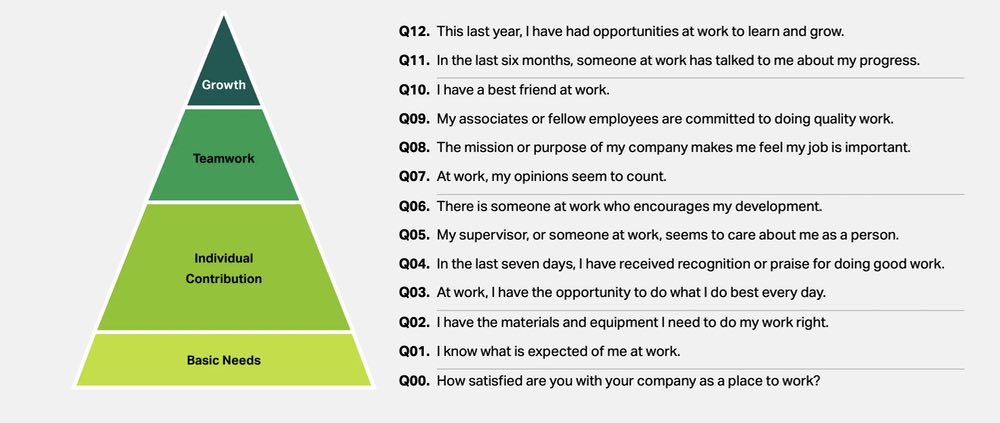
You could do this kind of survey with all employees annually, or you could add the questions to individual reviews. Either way, the responses give you a chance to understand employee engagement at individual, department, and company-wide scales.
You don’t need 100% engagement
When it comes to employee engagement, the goal is not total engagement every moment of every day. (Total engagement sounds a little culty, to be honest.)
Even people who love their jobs wholeheartedly have times when they are not fully engaged. There are many perfectly reasonable reasons why you may not be in a state of flow at this exact moment in time, from family stuff to world events, and from the specific task you’re working on to when you last ate. That’s fine.
Not all the people in your organization will be equally engaged, either. Yours may be the best group in the world, but someone may still be ready to try a different line of work. That’s also fine.
Perfection isn’t necessary. What matters most is that leaders understand whether or not people feel engaged and what drives that sentiment. Engagement affects individual well-being, team performance, and ultimately your group’s ability to fulfil its mission. In a way, it’s the most important indicator of your potential for impact. And that’s what counts.
Where to begin with employee engagement
Here are a few things you could do today to better understand and strengthen employee engagement in your social impact organization:
- Plan your own employee engagement survey. Get the facts, if you don’t yet have employee engagement data. Use a tool like Gallup Q12, or any approach that suits your culture.
- Download the Changemaker Wellbeing Index and look for the insights that might help your organization. In particular, check out the five HR practices common to thriving organizations mentioned on page 33.
- Share this article with your organization’s managers and talk about if / how you can work together to support engagement and well-being.
- Ask for help yourself. If you are struggling with engagement or feeling burned out, this is a good time to do something about it. Friends, family, coaches, advisors, peer groups, and therapists can all help you find your way back to yourself. Pick someone you trust and start the conversation.
Employee engagement is not just a buzzword. Employee engagement is a critical indicator of thriving, sustainable nonprofit organizations—and those organizations, in turn, are critical parts of our society. If you haven’t been paying attention, it just might be time.
The Organizer is a newsletter for people working to create equitable and sustainable communities. Whether you are part of a nonprofit, a charity, or a social enterprise, this newsletter is for you.
Each edition, we explore one aspect of social impact work. We answer a common “How do I …?” question, and we tell you about a tool that will help make your work a little easier. Subscribe for free at Entremission.com.